Showing posts with label Powder Fertilizer Production. Show all posts

Monday, 21 December 2020

Powder Fertilizer Production Process

Project Basis

Powdery organic fertilizer refers to the fertilizer produced by organic raw materials in a certain proportion without producing particles. It is different from the traditional stack fermentation. The national standard is 40% organic matter, more than 5% total nutrients and 30% moisture. The equipment is also relatively simple, mainly the fermentation trilogy, namely: premixing, turning, refining, packaging. The main purpose of fermentation is that macromolecular materials of organic materials are decomposed into small molecular materials by microorganisms, which can be absorbed and utilized by crops. The quality of fermentation is also related to the quality of organic fertilizer and the effect of fertilizer.

Powder fertilizer VS Granules 

The production process of organic fertilizer is relatively simple, and the production process of organic fertilizer is much smaller than that of organic fertilizer. The production line of powdery organic fertilizer has the advantages of simple process, less investment and less land occupation. The investment amount depends on the amount of raw materials. Although more and more customers choose granular organic fertilizer production lines, powdered organic fertilizer production lines are also popular on many small farms.

Detailed fertilizer production process

Generally, there are few equipments used in the production line of powdery organic fertilizer. Usually as follows:

1. Fermentation turning machine or organic fertilizer turning machine is used for powder or granular organic fertilizer equipment;

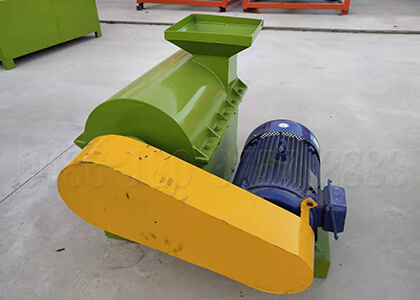
2. Material crusher, one of the basic equipment for organic fertilizer processing;

3. Screening machine, screening out the raw materials exceeding the powder requirements, and then crushing them;

4. Automatic weighing and packaging machine.

Small powder organic fertilizer production line generally selects small pre mixer, shallow trough turntable or strip type turntable, refining device, automatic packaging machine, etc.

Recommended Equipment for powder fertilizer production

The premixing equipment of large-scale powdery organic fertilizer production line generally selects double screw mixer or unpowered mixer. Stacker selection shallow groove turntable or spiral turntable or chain type turntable, usually according to their own capital status and degree of automation. It depends on the height. Refining equipment should choose 2-3 large crushers, or choose screening and crushing to save some energy, because the organic raw materials of fermentation are relatively large in water, it is difficult to crush, and the equipment power is relatively large. The screening and refining equipment with high output, high efficiency and energy saving must be selected. Final packaging, this packaging must choose organic fertilizer powder packaging machine.

Wednesday, 8 July 2020

Fertilizer Grindering Process


Chicken manure fertilizer crusher

Crusher, the main equipment of fertilizer production

The main process of compound fertilizer production includes crushing, mixing, granulation, drying and cooling, screening, packaging, etc. According to different fertilizer production process, the requirements of raw material particle size are also different. In the production of organic fertilizer, in order to speed up the fermentation reaction and improve the uniformity of raw material mixing, it is necessary to combine the fermentation raw materials in advance. In the process of chemical fertilizer production, in order to facilitate granulation, raw materials need to be further crushed before granulation. The unqualified large particles or a large amount of materials formed after granulation need to be crushed and returned to the granulation system. Therefore, fertilizer production needs different types of crushing equipment, commonly used crushing equipment are straw crusher, chain crusher, cage crusher, semi wet material crusher.

Straw crusher is suitable for cutting organic fertilizer raw materials, such as corn straw, rice straw, tobacco, peanut straw, sweet potato seedlings, branches and bark. The raw materials can be used not only for organic fertilizer production, but also for raising cattle, sheep and other livestock.
Straw crusher

Cage crusher is especially suitable for crushing materials with high hardness. It has simple structure, good crushing performance and strong sealing property. It is widely used to crush organic minerals, compound fertilizers and fertilizer granules.
Semi wet material crusher is mainly used to crush water pressure agent, such as fermented livestock manure, sludge, residue and other materials with water content of 25-50%, so as to make the particle size of crushed material meet the requirements of granulation.

Chain crusher is divided into vertical chain crusher and horizontal chain crusher. This machine is suitable for crushing raw materials and returning materials before granulation in chemical fertilizer production line. It is widely used in chemical industry, building materials, mining and other industries.

Cage crusher semi wet material crusher chain crusher

In the production of chemical fertilizer, the selection of crusher and the setting of parameters are determined according to the needs of crushing. Then the comminution technology and design of fertilizer production process are determined. Combined with the characteristics of the separator, a reasonable fertilizer granulation production line is designed to maximize the production efficiency. The selection of chemical fertilizer machine should be considered as much as possible, and attention should be paid to the problems of cost, energy consumption and efficiency. More different types of crushers used in fertilizer production, welcome to
https://organicfertilizermachines.com/fertilizer-crusher/

Wednesday, 11 March 2020

Pellet Fertilizer VS Powder Fertilizer

Fertilizer can be something that has been employed in producing crops, and the repair of fields, throughout history. Even ancient civilizations had an awareness that when you grew the identical crops over a field year after year, yields would decline, and that manure was beneficial to 'breathe life' into the soil.


Today, we count on intensive farming methods and have huge fields of crops. Gathering, storing, transporting and applying manure inside the quantities found it necessary to keep those fields going can be impractical, expensive, and smelly, in addition to potentially unhygienic!

The application of Commercial Fertilizer Pellets

Fertilizer pellets give a practical solution, to be able to produce fertilizer potent enough to treat fields, such as convenient and straightforward to deal with balls or cylinders. These pellets have the nitrogen along with other nutrients that must sustain crops, but are reduced in moisture (and thus odor) and are simpler to handle and transport. Want to know how to make pellet fertilizer, right here in CMT you can get the whole process in pellet fertilizer production.


Since the pellets are dry, they are more hygienic to deal with. They also occupy less volume compared to equivalent 'dose' of wet fertilizer to take care of a field and weigh less too. As a result them suitable for large scale applications.

Slow Release and Controlled Dose

Another benefit of pellet form fertilizers for agricultural use is it can be done to create slow-release nitrogen fertilizers, that will give out a controlled dose since they are split up. This really is far preferable over the 'spread and hope' method of using manure. Furthermore, it gives farmers some degree of control of the waste byproducts that fertilizing their fields produces.


Pellets vs Liquid Fertilizers

Liquid fertilizers have long been used as a substitute for manure, and liquids do have some benefits too, considering they are an easy task to handle as well as simple to use. Liquid fertilizers, however, require special equipment to use, plus they are susceptible to damage and decay. Liquid fertilizer must be applied frequently for best results, and if the doses are incorrect chances are they may actually damage plants.

In comparison, it can be simpler to store and apply pellets, and you may not must apply them as much as you should spray liquids. Pellet fertilizers give you a relatively uniform dose (however, not as precise while you could theoretically get with liquids.


Pellet fertilizers are great for making sure crops obtain access to nitrogen, but you should make sure the pellets are certainly not loaded with salt, because that will damage leaves. In addition, you will still have to monitor the soil for your amounts of phosphorus along with other nutrients which must be transported in water to arrive at the roots of the plants.

Making Your Personal Fertilizer

Today, it is relatively simple for farmers to produce their very own fertilizer using pan granulation machines. When you are linked to a large scale agricultural operation then you should consider carrying this out, to be able to enjoy the benefits of having simple to transport and store fertilizer to treat your fields with when it can be needed.