Showing posts with label Bio-tech. Show all posts

Tuesday, 15 September 2020

Biological Fertilizers Types

Different types of biological fertilizers have different uses. The amount of pure biological fertilizer is less, generally 0.5-2 kg per mu, used for seed dressing, root or leaf spraying. For example, Soybean Rhizobium fertilizer can be inoculated by slurry method. Generally speaking, 30-75 kg / mu is used as seed fertilizer for mechanical sowing. Generally speaking, the amount of bio organic fertilizer is large, 50-80 kg / mu is used as basic fertilizer. When bio organic fertilizer was used as basic fertilizer in dry land, it was applied in autumn and spring in combination with the whole field. Paddy field is used as basic fertilizer and biological fertilizer is applied once before water.

Fermenter for bio-fertilizer production

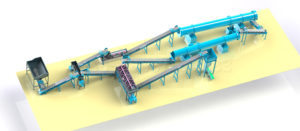
Biological fertilizer production line can adopt different raw materials and processes to make special fertilizer suitable for different crops. In the batch processing stage of biological fertilizer production, NPK inorganic fertilizer and other nutrients needed by crops are added and granulated by chemical fertilizer granulator, which can be processed into bio organic inorganic compound fertilizer. Bio organic inorganic compound fertilizer combines the dual advantages of organic fertilizer and inorganic fertilizer, which ensures that crops can obtain nutrition in short term and fertilizer effect in long-term supply. The fertilizer granulator of the biological fertilizer production process makes the raw materials into granules, which is convenient for the storage and use of the products.

Application of biological fertilizer

1. The manufacturer of chemical fertilizer machine reminds you that the effect of applying bio organic fertilizer on the basis of conventional fertilization is the best, and biological fertilizer should be applied continuously. If the fruit trees need phosphorus and potassium, not only can not reduce phosphorus and potassium fertilizer, but also increase phosphorus and potassium fertilizer appropriately. In the application of P and K, some soil lacking P and K should be increased. The combination of biological fertilizer, organic fertilizer and inorganic fertilizer has the best promoting effect on crops.

2. It should be noted that due to the nature of biological fertilizer, it should not be mixed with ammonium bicarbonate, plant ash, potassium sulfate, ammonium sulfate, etc., otherwise, the fertilizer efficiency of bacterial fertilizer will be affected.

3. When biological fertilizer is used as basic fertilizer or top sheet, it should be covered with soil in time to avoid affecting fertilizer efficiency. Want to get to know bio-fertilizer production process, welcome to https://organicfertilizerplants.com/bio-organic-fertilizer-production/


Thursday, 27 August 2020

Pan Granulation Technology

As a fertilizer granulator which has been used for a long time in chemical fertilizer plant, pan granulator has its unique advantages. In the production of fertilizer granulation, the following factors exist in the particle uniformity.

Structure of pan pan granulator

The disc granulator adopts the whole arc structure, which effectively improves the granulation rate. Combined with non power scraper equipment, it can reduce the accumulation of materials in the granulation process and maximize the use of raw materials. In order to facilitate the flexibility and flexibility of field use, the base is firmly thickened and weighted, without the need for additional anchor screws to fix, which also helps to prevent chassis deformation. The disc granulator is very suitable for field operation, reduces the tedious installation and layout procedures, saves time and improves the work efficiency.

In the granulation stage of NPK fertilizer production line, with the continuous addition of raw materials, under the action of centrifugal force, the manufactured particles fall into the lower belt conveyor through the edge of the plate.

Pan fertilizer granulator

Elements of Pan fertilizer granulator

When the plate granulator processes raw materials, many parameters affect each other. For example, the smaller the diameter of the pelletizing disk is, the lower the disk height is, the larger the inclination angle of the disk is, and the higher the rotation speed is; if the disk height is increased, the inclination angle and rotation speed are higher. The smaller the tilt, the lower the speed.

As a NPK compound fertilizer production equipment, another factor affecting the disc granulator is the tilt angle of the disc. The angle of inclination should not be less than 35 ° during granulation, otherwise the material will stick to the disc and rotate with the disc body. With the increase of inclination angle and rotation speed, the material can avoid accumulating in the lower part without falling and rolling up and down.  More info on pan granulation process, go here with the link.

However, the larger the inclination angle is, the faster the downward rolling speed is, and the smaller the overflow particles are. The most suitable slant point of the disk is related to the diameter of the disk, that is, the slope of the disk decreases with the increase of the disk diameter. 

This is because the end velocity of particles moving along the disk surface increases as the disk diameter increases. In order to avoid the impact and fracture of other particles when the particles are down, the tilt of the disk must be reduced.

Wednesday, 10 June 2020

Bio-organic fertilizer production process

Bio-organic fertilizer refers to the main raw material of livestock and poultry manure, inoculated with microbial complex bacteria, fermented and decomposed to completely kill pathogens, insects and eggs, fertilizers with microbial fertilizer and organic fertilizer effect, etc. Bio-organic fertilizer generally contains a lot of Nitrogen, phosphorus, potassium and other elements and calcium, magnesium, sulfur, iron, boron and other trace elements, as well as a large amount of organic matter and humic acid substances, make the fertilizer supply balanced. The bio-organic fertilizer production line processes the fermented material into the final organic fertilizer.
Raw material for bio-organic fertilizer production
The main raw materials for bio-organic fertilizer production are agricultural wastes such as livestock and poultry manure and crop straws.


Mixed ingredients in bio-organic fertilizer production

The source of raw materials, fermentation method and equipment are different, and the ingredients are also different. The specific formula depends on the source of the organic material. The general principle of ingredients is: the organic matter content of the total material should be greater than 30% (preferably 50%-70%), carbon to nitrogen ratio (15:1)-(20:1), pH value should be 6-7.5, including The water content should be around 50%, and the water content should be adjusted to 50%-70% during inoculation.

Fermentation maturity

It can be laid flat or fermented in a fermenter. Fermentation tanks are usually placed in closed or semi-closed fermentation chambers. The effect is better than flat ground. Every three days, you need to use a fertilizer turning machine to turn it regularly. After 25-30 days of fermentation, the temperature is gradually reduced from 70-80°C to stable, and the decomposition is completed.

Bio-organic fertilizer production equipment and process

Crushing and mixing pretreatment

Crushing equipment: semi-wet material crusher

This machine is mainly used for crushing biofermented organic fertilizer materials with 25% to 50% moisture. The crushing particle size meets the granulation requirements, and can also be adjusted within a certain range according to user needs. It has a good effect on crushing hard materials such as glass bricks, ceramics and crushed stones in organic fertilizer for municipal solid waste.

Mixing equipment: horizontal mixer

The mixer is mainly used for batch mixing of raw materials, and the materials can be fully stirred. The mixing rate is high and the residue is less. It is suitable for the mixing of feed, concentrated feed and premix additives.

Bio-organic fertilizer production process

Granulation equipment

After composting, the material needs to be granulated to have a certain strength and shape before it can be used as an organic fertilizer. Granulation is a key step in the production of bio-organic fertilizer. There are many types of bio-organic fertilizer granulators. According to the structure of the granulator, the aggregate method can be divided into disc granulator, drum granulator, and new organic fertilizer granulator. According to the position of the press roll, the extrusion method can be divided into a double roll press granulator, a flat die granulator and a ring die granulator.

Disc granulator for bio-granular fertilizer production: Disc granulators are widely used, producing less coarse particles, and the granulation rate is greater than 90%, but the powder fineness requirements are higher.

Drum granulator machine: suitable for mass production of cold and hot granulation and high, medium and low concentration compound fertilizers.

New organic fertilizer granulator: used for granulating organic matter after fermentation, it is the latest technology product with many years of research experience.

Double-roller press granulator: The machine has two shafts, one shaft is fixed and the other shaft is movable. The distance between the two shafts can be adjusted. The shaft material will be extruded between the shafts. The material is granulated at room temperature, no drying process is needed, which saves energy and reduces consumption.

Flat die granulator: There is no need to dry and crush raw materials before granulation. It can directly dispense cylindrical particles and save a lot of energy.
More details of different types of granulators, welcome to https://fertilizergranulatorfactory.com/


Screening equipment

Drum screening machine: There is a certain difference in the particle size output by the granulation molding system, which requires screening and classification. The drum screening machine has the advantages of low vibration, low noise, and convenient screen change. The production line is equipped with an automatic feedback system, which screens the unqualified large and small particles, conveys them through a belt hoist, and then crushes them and sends them to the granulator to continue granulation, which is conducive to improving the continuous operation capacity of the production line.
Vibration screening machine: It has better screening effect on materials, but it has more dust than drum screening machine when working.